
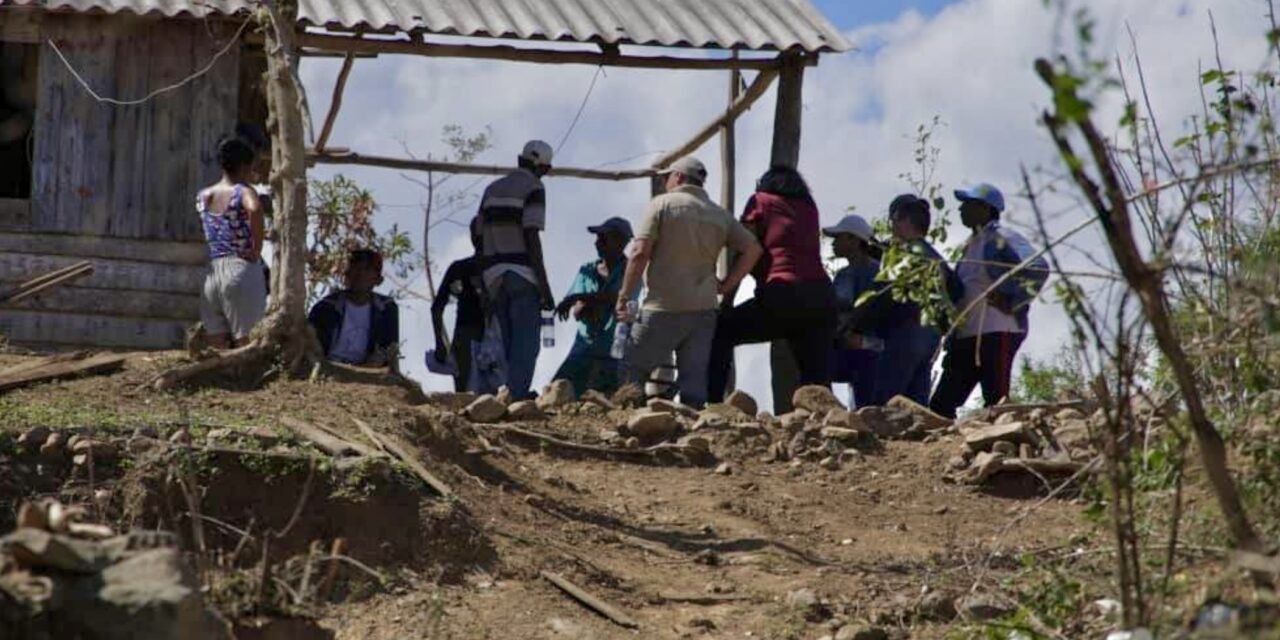
Photo: Cuba’s Martin Luther King Memorial Centre (CMMLK) is working with local communities in eastern Cuba to ensure safe arrival of food and other supplies to eastern Cuba in the wake of Hurricane Melissa. (Photo: CMMLK/Facebook)
As the people of Cuba face outbreaks of chikungunya and devastation provoked by Hurricane Melissa, non-governmental organizations including churches and trade unions are doing what they can to help.
But the government of Canada needs to increase food and medical aid to Cuba and to work with other countries to ease the impact of U.S. sanctions. In November, 2025, the Red Cross announced that Cuba has only received 16.3 per cent of the humanitarian aid that it needs.
It’s a time of exceptional need. Hurricane Melissa arrived as Cubans struggled with mosquito-borne viruses like chikungunya and dengue. As we celebrate Canada’s contribution of almost CAD $6.5 million to relief efforts carried out by various agencies, Cuba is still suffering an economic slump provoked by the COVID pandemic. Effects of the downturn are magnified by the decades-long imposition of sanctions (sometimes referred to as the “embargo” or the “blockade”) by the United States.
What’s Happening in Cuba
Cuban partner organizations and recent visitors say conditions in Cuba today are much more difficult than in the early 1990s when the implosion of the Soviet Union led to a massive deterioration in living standards. The pandemic shuttered the tourism industry, a main source of revenue used to acquire food, medicines and fuel from abroad. Cuba has also suffered a series of hurricanes, droughts and floods, leading to lost crops and food shortages. Energy shortages limit public transit and even the collection of garbage. Punitive U.S. measures under both Biden and Trump have also reversed the many gains delivered by the easing of such measures by the Obama administration.
The return of Trump in 2025, and appointment of Marco Rubio, a vocal proponent of increased sanctions on Cuba, as U.S. Secretary of State, has meant additional pressure. U.S. measures not only restrict U.S. citizens and businesses from providing support to the Cuban people, they also interfere with the delivery of humanitarian aid by other countries because banks limit transactions; suppliers face risks of U.S. retaliation; shipping of freight becomes more complicated and costly.
Try to imagine what living conditions are like for the average Cuban:
- Daily power outages
- Spending 70% of income on food
- Monthly salary of US$16-23, enough for 3 kilos or powdered milk or a tray of 30 eggs
- Pension for seniors is about US$5/month
- Ration book supplies cut drastically: no coffee, bread rolls reduced from 80 to 60 grams
- Hospital conditions have deteriorated: the infant mortality rate has increased 50% in recent years; 12,000 doctors (with a similar number of nurses) have left the profession
- Rise in mosquito-caused disease, and in particular chikungunya. Fifty-thousand cases or more—due to poor sanitation related to lack of fuel or spare parts for garbage trucks
- Cuba imports 80% of its food as national production dropped
- Cuban tourism is down 20 per cent in 2025.
- Cuba is now a country divided by currency—with rampant dollarization. Those with dollars can get by; those dependent upon the peso are in deep trouble.
- There are now 60 gas stations and 209 stores that serve only in USD$
- Friends and family are leaving: as many as 1 million since 2020, mostly from 15-49 age cohort
- Hurricane Melissa affected 3.5 million people. Data are still incomplete, but some important figures:
- 750,000 (in a population of 9 million) were evacuated; by mid-November, 120,000 had still not been able to return home.
- Melissa damaged at least 95,000 homes, 1,500 schools and 460 healthcare centres. About 4,300 houses collapsed. Over 78,000 hectares of crops were damaged, and 28,000 livestock drowned.
- Power and telephone lines are still down in some areas. In mid-November, 60% of the people of Santiago province were still without electricity
Fortunately, asking Canada to support Cuba in this way is consistent with Canada’s history of strong relations with Cuba and maintained an independent foreign policy:
- Canadian non-governmental organizations, faith-based groups, trade unions and civil society groups have worked continuously with Cuban partners to maintain strong people to people connections and to provide humanitarian and development assistance.
- In 2024, Canada contributed $1.7 million in humanitarian assistance in response to several emergencies including Hurricanes Oscar and Rafael. Funds were shared via multilateral agencies including the World Food Program (including $12 million from 2025 to 2029 for an inclusive food security and nutrition program in Cuba) and UNICEF, along with NGOs including CARE Canada, the Canadian Red Cross, and Humanity and Inclusion.
- Canadian “blocking legislation” seeks to protect Canadian corporations from of U.S. measures that aim to prevent foreign countries from engaging in international trade with Cuba.
- Canada and Mexico were the only two countries in the Western hemisphere in the 1960s to preserve diplomatic relations with Cuba.
- Cuba was the first country to be granted permission to fish in Canadian waters when Canada extended the 12-mile territorial limit to 200 miles.
- Today, Canadians comprise the largest number of tourists to visit the island (34% of all tourists to the island),
- Cuba is Canada’s top market in the Caribbean/Central American sub-region and is Canada’s largest merchandise export market in that region.
Resources
United Church support for farmers with dis abilities in Cuba
https://www.youtube.com/watch?v=Flfb2ax8Sj8&list=PLQDu-SgFb3RhYlxVfQOxbo1DjO9ezW-sR&index=8&t=191s
Biden’s Cuba Policy Leaves the Island in Wreckage
https://www.dropsitenews.com/p/where-to-watch-the-debateand-a-dispatch
Crisis in Cuba: a role for Canada?
https://canadiandimension.com/articles/view/crisis-in-cuba-a-role-for-canada
To counter the impact of U.S. measures, Canada should take these actions:
- Continue to scale up efforts to provide immediate food, medicines and medical supplies and ongoing development assistance to Cuba;
- Strengthen Canada’s commitment to an independent foreign policy with Cuba based on dialogue, constructive engagement and respect for self-determination rather than punitive measures such as sanctions that only hurt the Cuban people;
- Work with other countries, including from Latin America, the Caribbean and others, to prevent U.S. measures that isolate and harm the Cuban people from interfering with the delivery of humanitarian assistance by other countries, including Canada.


